
THE MINOR PROPHETS
This is a collection of 12 books located at the end of the Old Testament scriptures – from Hosea to Malachi. The designation “Minor Prophets” does not relate to their relevant importance. The term “Minor” refers to the length of the books when compared to the length of the writings of the “Major Prophets“, Isaiah, Jeremeiah, Ezekiel and Daniel.
The books cover a period from about 845BC to 400 BC.
The Role of The Prophets
The prophets (both “Minor” and “Major“) were servants of God, divinely appointed and inspired to proclaim His Word. At times, they were messengers of God’s word as it applied to the present (“forthtelling“), serving as watchmen on behalf of the people of God; other times, God’s message pertained to the future, and as such they were known as “seers” (“Foretelling“) things to come.
They often acted as advisors to the King – directing the monarch to fulfil the will of God – a role not always heeded by the monarch at the time.
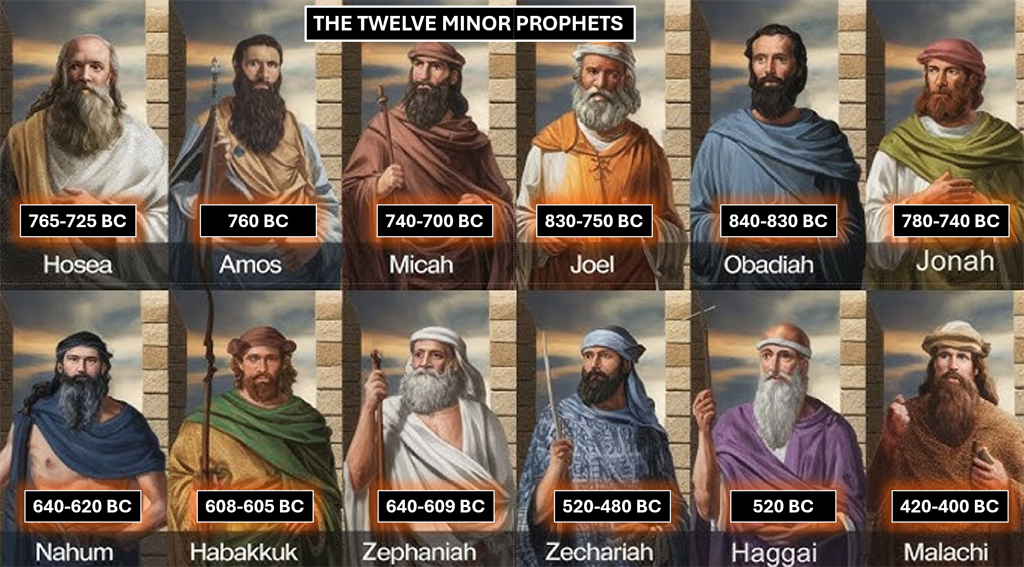
Chronological Order of the Prophets
The following is an estimate of the dates during which each of the Prophets ministered. This can be divided into FIVE DISTINCT PERIODS from the time of the DIVIDED KINGDOM through to the POST BABYLONIAN CAPTIVITY period …
9th CENTURY BC
(EARLY ASSYRIAN PERIOD)
1. Obadiah (ca. 845 B.C)
2. Joel (ca 830 B.C.)
3. Jonah (790-750 B.C.)
This was during the period of “The Divided Kingdom” in Israel’s history; to the north and east the empire of Assyria was beginning to make its presence known in Israel, seeking to extend its territory.
8th CENTURY BC
( ASSYRIAN PERIOD)
1. Amos (755 B.C.)
2. Hosea (750-725 B.C.)
3. Isaiah (740-700 B.C.)
4. Micah (735-700 B.C.)
In 721 B.C., the northern kingdom of Israel was taken into Assyrian captivity; these
prophets were proclaiming God’s message as the nation was being threatened and overtaken from the north
7th CENTURY BC
(BABYLONIAN PERIOD)
1. Jeremiah (626-586 B.C.)
2. Zephaniah (630-625 B.C.)
3. Nahum (625-612 B.C.)
4. Habakkuk (625-605 B.C.)
Assyria was eventually defeated by Babylon and the Medes; these prophets served as God’s messengers when the Babylonian empire threatened to invade the Southern kingdom of Judah.
6th CENTURY BC
(BABYLONIAN EXILE)
1. Ezekiel (593-570 B.C.)
2. Daniel (605-536 B.C.)
These prophets were taken into Babylonian captivity, along with many of the population of the Sothern Kingdom of Judah; from Babylon they served as God’s messengers to both captives and kings.
6th & 5th CENTURIES BC
(POST-EXILIC PERIOD)
1. Haggai (520 B.C.)
2. Zechariah (520-518 B.C.)
3. Malachi (ca. 440 B.C.)
After the Jews were allowed to return home from Babylon, God used Haggai and Zechariah to encourage the people to rebuild the temple; later, Malachi was used to reform the priesthood during the time of Ezra and Nehemiah
The Messages of the Minor Prophets
Obadiah
- Historical Context and Background
The Book of Obadiah is the shortest book in the Old Testament, written after Jerusalem’s destruction by the Babylonians. It addresses the betrayal of the Israelites by the Edomites, descendants of Esau, who took advantage of Judah’s calamity (Obadiah 1:10-14). This conflict is rooted in the ancient rivalry between Jacob and Esau (Genesis 25:23; Obadiah 1:6). - The Sin of Edom: Pride and Betrayal
Obadiah’s prophecy highlights Edom’s pride and arrogance. The Edomites felt secure in their mountainous territory, but their confidence led them to gloat over Israel’s downfall and participate in its suffering (Obadiah 1:3-4, 12-14). Their actions serve as a warning about the dangers of pride and betraying one’s kin. - Divine Judgment Pronounced
God, through Obadiah, pronounces judgment on Edom, declaring that their pride will lead to their destruction. The Lord promises to bring Edom down from their heights and leave them desolate (Obadiah 1:2-4, 8-9). This judgment is both a response to Edom’s betrayal and a warning to all nations about the consequences of pride and violence. - The Day of the Lord: Universal Justice
Obadiah’s prophecy extends beyond Edom, proclaiming a coming “Day of the Lord” when God will bring justice to all nations. The principle is clear: “As you have done, it will be done to you” (Obadiah 1:15). This underscores the certainty of divine retribution for those who act with pride and violence. - Restoration and Hope for Israel
Amid judgment, Obadiah offers hope for Israel. God’s people will be restored, reclaim their land, and experience deliverance on Mount Zion (Obadiah 1:17-20). The final verses envision a future where God’s kingdom is established, justice prevails, and the faithful are vindicated (Obadiah 1:21). - Themes: Justice, Humility, and Sovereignty
Obadiah’s message emphasizes the dangers of pride, the necessity of humility, and God’s sovereignty over nations (Obadiah 1:3-4, 21). The book teaches that no nation is immune to divine accountability and that God opposes the proud but gives grace to the humble (see also James 4:6 for a New Testament parallel). - Enduring Lessons and Relevance
Though brief, Obadiah’s prophecy delivers timeless lessons. It calls readers to humility, compassion, and trust in God’s righteous rule. The story of Edom and Israel warns against pride and betrayal, while the promise of restoration encourages faith in God’s ultimate justice (Obadiah 1:15, 17, 21).
Joel
- Historical Context and Identity of Joel
Joel, whose name means “Yahweh is God,” was a prophet to the southern kingdom of Judah. The exact date of his ministry is debated, but many scholars place it around 835 BC, during the reign of the young King Joash. Joel’s background is largely unknown, except that he was the son of Pethuel (Joel 1:1). His ministry took place during a time of national crisis, marked by a devastating locust plague and drought, which he interpreted as divine judgment. - The Locust Plague as Divine Judgment
The book opens with a vivid description of a locust invasion that ravaged Judah, destroying crops and causing famine (Joel 1:2-4). Joel uses this catastrophe as a metaphor for God’s judgment on the people’s spiritual neglect. He calls the elders and all inhabitants to witness the disaster and recognize it as a wake-up call to repentance (Joel 1:13-14). The locusts symbolize both a literal and figurative warning of greater judgment to come if the nation does not return to God. - The Call to Repentance
A central feature of Joel’s message is the urgent call to genuine repentance. He urges the people to “return to Me with all your heart, with fasting, weeping, and mourning. Rend your hearts and not your garments” (Joel 2:12-13). Joel emphasizes that God desires heartfelt contrition rather than mere outward ritual. This call is directed to all people, including priests, elders, and even children, highlighting the communal responsibility for spiritual renewal. - The Day of the Lord: Judgment and Hope
The “Day of the Lord” is a dominant theme in Joel’s prophecy, representing a time of divine intervention, judgment, and ultimately, restoration (Joel 1:15; 2:1; 2:31; 3:14). Joel describes this day with apocalyptic imagery—darkness, fire, and cosmic disturbances (Joel 2:1-11; 2:30-31). While it is a day of terror for the unrepentant, it also holds the promise of salvation for those who turn to God. This dual aspect underscores both God’s justice and mercy. - Promise of Restoration
Despite the warnings, Joel’s message is ultimately one of hope. God promises to “repay you for the years the locusts have eaten” (Joel 2:25), signifying material and spiritual restoration. The land will be renewed, and the people will again experience abundance and blessing (Joel 2:21-27). This restoration is contingent upon the people’s repentance and return to God, demonstrating His readiness to forgive and bless. - The Outpouring of the Spirit and Prophetic Fulfillment
One of Joel’s most significant prophecies is the promise that God will “pour out My Spirit on all people” (Joel 2:28-29). This democratization of prophecy—where sons, daughters, old, and young will prophesy, dream, and see visions—was fulfilled at Pentecost (Acts 2:16-21). Joel’s prophecy thus bridges the Old and New Testaments, highlighting the continuity of God’s redemptive plan and the empowerment of all believers by the Holy Spirit. - Prophetic Importance
Joel’s message carries profound prophetic significance. The “Day of the Lord” points to both historical judgments and future eschatological events, including the final judgment and the ultimate restoration of God’s people (Joel 3:1-21). Joel’s emphasis on repentance, restoration, and the outpouring of the Spirit has shaped both Jewish and Christian thought, inspiring hope in God’s justice, mercy, and faithfulness to His promises.
Jonah
- Jonah’s Unique Prophetic Calling
Jonah, son of Amittai, is introduced as a prophet during the reign of Jeroboam II (2 Kings 14:25). Unlike most prophetic books, which focus on oracles, the Book of Jonah is primarily a narrative centered on the prophet’s personal journey. God commands Jonah to go to Nineveh, the capital of Assyria, and preach against its wickedness (Jonah 1:1-2). This commission is remarkable because it directs a Hebrew prophet to deliver God’s message to a foreign, enemy nation, highlighting the universal scope of God’s concern. - Jonah’s Flight and God’s Pursuit
Instead of obeying, Jonah attempts to flee from God’s presence by boarding a ship to Tarshish (Jonah 1:3). His disobedience leads to a violent storm, and Jonah is eventually thrown overboard by the sailors to calm the sea (Jonah 1:4-15). God appoints a great fish to swallow Jonah, where he remains for three days and three nights (Jonah 1:17). This episode underscores the futility of resisting God’s call and the lengths to which God will go to accomplish divine purposes. - Repentance and Deliverance
Inside the fish, Jonah prays a psalm of repentance and thanksgiving, acknowledging God’s sovereignty and mercy (Jonah 2:1-9). God commands the fish to vomit Jonah onto dry land, granting him a second chance (Jonah 2:10). This act of deliverance not only demonstrates God’s willingness to forgive but also prefigures the theme of resurrection and new beginnings, which Jesus later references (Matthew 12:39-41). - Jonah’s Message to Nineveh
God’s command comes to Jonah a second time, and this time he obeys, proclaiming, “Forty more days and Nineveh will be overturned!” (Jonah 3:4). The people of Nineveh, from the king to the commoners, believe God, fast, and don sackcloth in repentance (Jonah 3:5-9). God sees their genuine repentance and relents from the destruction He had threatened (Jonah 3:10). This episode highlights the power of God’s word to bring about repentance and the inclusivity of divine mercy. - Jonah’s Anger and God’s Compassion
Rather than rejoicing in Nineveh’s salvation, Jonah becomes angry, revealing his struggle with God’s compassion for Israel’s enemies (Jonah 4:1-3). God uses a plant to teach Jonah about mercy, pointing out that if Jonah can pity a plant, God can certainly have compassion on the people of Nineveh (Jonah 4:10-11). This lesson challenges readers to reflect on their own attitudes toward grace and forgiveness. - Prophetic and Messianic Significance
Jonah’s three days in the belly of the fish serve as a prophetic sign, foreshadowing Jesus’ death, burial, and resurrection. Jesus explicitly references Jonah’s experience as a “sign” to His generation (Matthew 12:39-41; Luke 11:29-32). The repentance of the Ninevites stands in contrast to the unrepentant attitude of Jesus’ contemporaries, emphasizing the necessity of responding to God’s call with humility and faith. - Themes and Relevance Today
The Book of Jonah explores themes of obedience, repentance, divine mercy, and the universality of God’s salvation. It challenges ethnocentrism and self-righteousness, reminding believers that God’s compassion extends to all people, not just a chosen few (Jonah 4:2, 11). Jonah’s story calls readers to embrace God’s mission, confront personal prejudices, and participate in the proclamation of grace to the nations (cf. Matthew 28:19-20).
Amos
- Amos’s Background and Calling
Amos was a shepherd and a sycamore fig farmer from Tekoa, a small town in Judah. Despite his humble origins and lack of formal prophetic training, God called Amos to deliver a message to the Northern Kingdom of Israel during a time of political stability and economic prosperity under King Jeroboam II (Amos 1:1; 7:14-15). His background connected him to the struggles of ordinary people, making his message especially poignant. - Historical and Social Context
The era of Amos was marked by great wealth for the elite but also by deep social injustice, corruption, and religious hypocrisy. While religious rituals continued, they were empty of true devotion, and the poor were exploited. Amos’s ministry arose as a direct response to this moral decay, challenging the complacency of a society that mistook prosperity for divine approval (Amos 2:6-8; 5:21-24). - Central Themes: Justice and Righteousness
Amos’s prophetic message is centred on justice and righteousness. He boldly condemned the exploitation of the poor, corruption in the judicial system, and the emptiness of ritualistic worship without ethical living. His famous call, “Let justice roll down like waters, and righteousness like an ever-flowing stream” (Amos 5:24), encapsulates the heart of his message. - Universal Scope of Judgment
Amos’s prophecies were not limited to Israel. He began by pronouncing judgment on the surrounding nations for their transgressions (Amos 1:3–2:3), then turned to Judah and, most pointedly, to Israel itself (Amos 2:4-16). This structure initially gained him a receptive audience, but his sharp critique of Israel’s own sins was a challenging message for his listeners. - Warnings Against Empty Worship
A key feature of Amos’s ministry was his denunciation of religious formalism. He warned that God despised Israel’s festivals and offerings when unaccompanied by genuine repentance and ethical conduct (Amos 5:21-23). Amos insisted that true worship must be reflected in social justice and personal integrity. - Prophetic Importance and Messianic Hints
Amos’s ministry is significant for its emphasis on accountability before God and the inseparability of faith and justice. His prophecies include visions of judgment (Amos 7–9) but also a promise of restoration and hope: “I will restore the fallen booth of David” (Amos 9:11-15), which is later referenced in the New Testament as pointing to the inclusion of the Gentiles (Acts 15:16-17). - Enduring Relevance
The message of Amos remains relevant today, challenging individuals and communities to confront injustice, practice authentic worship, and recognize that prosperity is not always a sign of divine favor. Amos’s call to justice and righteousness continues to inspire believers to align their lives with God’s values and to advocate for the marginalized (Amos 5:14-15).
Hosea
- Introduction to Hosea’s Ministry
The prophet Hosea’s ministry is set during a turbulent period in Israel’s history, marked by spiritual decline and political instability. Hosea’s prophetic career spans the reigns of several kings (Hosea 1:1), and his message is unique for its use of personal experience—his marriage to Gomer—as a living symbol of Israel’s unfaithfulness to God. - Symbolism of Hosea’s Marriage
God commands Hosea to marry Gomer, a woman described as adulterous, to illustrate Israel’s spiritual infidelity (Hosea 1:2). The relationship between Hosea and Gomer mirrors the covenant between God and Israel, with Gomer’s unfaithfulness representing Israel’s idolatry and pursuit of other gods (Hosea 2:5). This vivid metaphor sets the tone for Hosea’s entire prophetic message. - The Charges Against Israel
Hosea’s message details the sins of Israel: idolatry, injustice, and reliance on foreign alliances rather than on God (Hosea 4:1-2, 7:11). The prophet warns that these actions will lead to judgment, including exile and suffering. Hosea’s prophecies are direct and uncompromising, calling the people to recognize their spiritual adultery and return to covenant faithfulness. - The Theme of Migration and Exile
A central feature of Hosea’s prophecy is the warning of Israel’s impending migration and exile as a consequence of their disobedience (Hosea 9:3, 11:5). Hosea predicts that Israel will be scattered among the nations, losing their land and identity. This migration is portrayed not only as punishment but also as a means for eventual purification and renewal. - God’s Persistent Love and Promise of Restoration
Despite the severity of the warnings, Hosea emphasizes God’s enduring love for Israel. The prophet uses the imagery of a loving husband who seeks to restore his wayward spouse (Hosea 2:14-23). God promises that, after a period of discipline, Israel will be restored, reunited, and blessed. The restoration includes a renewed covenant and the regathering of the people (Hosea 11:10-11, 14:4-7). - Prophetic Importance and Messianic Hope
Hosea’s message is prophetically significant because it introduces themes of redemption and messianic hope. The promise of restoration points forward to a time when God will heal Israel’s apostasy and love them freely (Hosea 14:4). Hosea’s prophecies are echoed in later biblical writings, emphasizing God’s faithfulness and the hope of salvation for all who repent. - Relevance for Today
The ministry and message of Hosea remain relevant for contemporary readers. Hosea’s call to repentance, his portrayal of God’s steadfast love, and the promise of restoration challenge individuals and communities to examine their own faithfulness. The book of Hosea reminds us that, despite human failure, God’s grace and desire for reconciliation endure (Hosea 6:1-3).
Micah
- Historical Context and Background
Micah was a prophet from Moresheth in Judah, active during the reigns of Jotham, Ahaz, and Hezekiah (Micah 1:1). His ministry occurred in the 8th century BCE, a time of moral decay, social injustice, and looming threats from Assyria. Micah’s rural background gave him a unique perspective on the suffering of the poor and the corruption of leaders. - Message of Judgment
Micah’s prophecies begin with a stern warning of judgment against both Israel and Judah for their sins—idolatry, oppression, and exploitation of the vulnerable (Micah 1:2-5). He denounces corrupt leaders, priests, and prophets for their greed and deceit (Micah 3:1-3, 3:5-7). The prophet vividly describes the coming destruction of Samaria and Jerusalem as consequences of their unfaithfulness. - Social Justice and Righteousness
A central theme in Micah’s message is God’s demand for justice, mercy, and humility. Micah 6:8 stands out as a summary of what God requires: “He has shown you, O man, what is good; and what does the Lord require of you but to do justly, to love mercy, and to walk humbly with your God?” This call to practical righteousness and compassion is a hallmark of Micah’s prophetic voice. - Denunciation of Religious Hypocrisy
Micah exposes the religious hypocrisy of the people, who worship with their lips but serve idols in their hearts (Micah 2:6, 3:11). He condemns false prophecy, bribery, and the abuse of power, highlighting how those in authority perpetuate injustice and marginalize the poor (Micah 2:2, 3:9-11, 6:10-12). - Messianic Prophecies and Hope
Despite the warnings of judgment, Micah offers hope for restoration. He prophesies the coming of a ruler from Bethlehem (Micah 5:2), a messianic prophecy later connected to the birth of Jesus Christ. Micah envisions a future reign of peace and justice, where nations will come to worship God and the faithful remnant will be restored (Micah 4:1-7, 5:4-5). - The Remnant and Restoration
Micah frequently refers to the “remnant”—the faithful few whom God preserves through judgment. The book ends with promises of mercy and restoration for this remnant, assuring that God’s covenant faithfulness will endure even in the face of Israel’s unfaithfulness (Micah 7:18-20). This theme underscores God’s persistent love and the hope of redemption. - Contemporary Relevance
Micah’s ministry remains relevant today, challenging individuals and communities to pursue justice, mercy, and humility. His message calls for self-examination and a return to the core tenets of faith, reminding us that God’s grace and desire for reconciliation endure. The book of Micah encourages the faithful to hold onto God’s promises, even amid adversity (Micah 7:7-9).
Zephaniah
- Historical Context and Background
Zephaniah prophesied during the reign of King Josiah of Judah (640–609 BC), a period marked by widespread idolatry, moral decay, and looming judgment. Zephaniah’s royal lineage (Zephaniah 1:1) may have given him access to the king’s court, and his ministry likely occurred just before Josiah’s reforms. His message was urgent, warning Judah of the coming “Day of the Lord” and calling for repentance. - The Day of the Lord: Judgment Announced
A dominant theme in Zephaniah is the “Day of the Lord”—a time of divine reckoning and judgment. Zephaniah opens with a sweeping declaration: “I will sweep away everything from the face of the earth” (Zephaniah 1:2). He describes this day as one of wrath, distress, and darkness, emphasizing that neither wealth nor power can save from God’s anger (Zephaniah 1:14–18). - Condemnation of Idolatry and Injustice
Zephaniah’s message targets Judah’s idolatry, syncretism, and moral corruption. The prophet denounces false worship, complacency, and violence (Zephaniah 1:4–9). He also condemns the leaders, prophets, and priests for their failure to guide the people in righteousness (Zephaniah 3:1–7). The sins of the nation have provoked God’s anger, leading to the threat of destruction. - Universal Judgment on the Nations
Zephaniah’s prophecy extends beyond Judah to include surrounding nations—Philistia, Moab, Ammon, Cush, and Assyria (Zephaniah 2:4–15). He warns that no nation is beyond God’s reach, and all are accountable for their pride and mistreatment of others. This universal scope highlights God’s sovereignty over all peoples and nations. - Call to Repentance and the Hope for a Remnant
Despite the warnings, Zephaniah calls the people to repentance: “Seek the Lord, all you humble of the land… seek righteousness, seek humility; perhaps you will be sheltered on the day of the Lord’s anger” (Zephaniah 2:3). The prophet holds out hope for a faithful remnant who will be spared and experience God’s salvation. - Promise of Restoration and Joy
The book concludes with a dramatic shift from judgment to hope. God promises to purify the lips of the peoples, remove the proud, and restore the fortunes of Israel (Zephaniah 3:9–20). The Lord declares, “The Lord your God is with you, the Mighty Warrior who saves. He will take great delight in you… He will rejoice over you with singing” (Zephaniah 3:17). This vision of restoration includes the gathering of the scattered, the removal of shame, and the celebration of God’s presence among His people. - Prophetic Importance and Contemporary Relevance
Zephaniah’s ministry is prophetically important for its dual emphasis on judgment and restoration. The “Day of the Lord” serves as both a warning and a promise—judgment for the unrepentant, but hope and renewal for the faithful. Zephaniah’s message challenges readers to take God’s holiness seriously, to seek humility and righteousness, and to trust in God’s ultimate plan for redemption and joy.
Nahum
- Historical Context and Background
Nahum’s ministry is set against the backdrop of the Assyrian Empire’s dominance, particularly its capital, Nineveh. Assyria was notorious for its brutality and oppression of neighboring nations, including Israel and Judah. Nahum, whose name means “comfort,” prophesied during a time when Assyria’s power was waning, and the Neo-Babylonian and Median empires were rising. The book is dated between the fall of Thebes (663 BC) and Nineveh’s destruction (612 BC) (Nahum 3:8-10). - The Character of God
Nahum opens with a majestic portrayal of God’s character: “The Lord is slow to anger but great in power; the Lord will not leave the guilty unpunished” (Nahum 1:3). God is described as jealous, avenging, and just, yet also a refuge for those who trust in Him (Nahum 1:7). This duality—God’s wrath against evil and His protection of the faithful—sets the tone for the entire prophecy. - Judgment Against Nineveh
The central message of Nahum is the impending judgment and destruction of Nineveh. Unlike Jonah’s earlier message, which led to Nineveh’s temporary repentance, Nahum’s prophecy declares that this time, judgment is final due to Nineveh’s return to violence, idolatry, and pride (Nahum 3:1-4). The vivid imagery in Nahum 2 describes the siege, chaos, and downfall of the city: “The shields of the soldiers are red… the chariots storm through the streets” (Nahum 2:3-4). - Reasons for Judgment
Nahum details the reasons for Nineveh’s destruction: cruelty, deceit, idolatry, and arrogance. The city is called a “city of blood, full of lies, full of plunder” (Nahum 3:1). God’s judgment is portrayed as a response to persistent wickedness and oppression, emphasizing that no nation is beyond God’s reach when it comes to justice. - Divine Sovereignty and Justice
A key theme in Nahum is the sovereignty of God over all nations. Earthly powers, no matter how mighty, are subordinate to God’s rule: “I am against you, declares the Lord” (Nahum 2:13). Nahum’s prophecy assures the faithful that God sees the suffering of the innocent and will bring down oppressors in His perfect timing. - Comfort and Hope for God’s People
While Nahum’s message is one of judgment for Nineveh, it brings comfort and hope to Judah. “The Lord is good, a refuge in times of trouble. He cares for those who trust in him” (Nahum 1:7). The prophecy reassures God’s people that justice will prevail and that their suffering under Assyrian oppression will end. Nahum 1:15 proclaims peace and good news for Judah: “Look, there on the mountains, the feet of one who brings good news, who proclaims peace!”. - Prophetic Importance and Contemporary Relevance
Nahum’s ministry is prophetically important for its emphasis on divine justice, sovereignty, and comfort for the oppressed. The book teaches that delayed judgment is not denied—God’s justice will come in His time. Nahum’s message remains relevant today, reminding us that God is not indifferent to evil and that He offers refuge to those who trust in Him. The fall of Nineveh stands as a testament to the certainty of God’s promises and the hope of deliverance for the faithful.
Habakkuk
- Historical Context and Background
Habakkuk prophesied during a time of great turmoil in Judah, likely in the late 7th century BCE, as the Assyrian Empire declined and the Babylonian Empire rose to power. The nation was marked by social injustice, moral decay, and the looming threat of Babylonian invasion. Habakkuk’s ministry took place amid this instability, as he sought to understand God’s purpose in the suffering and chaos surrounding Judah (Habakkuk 1:1). - Unique Structure: Dialogue with God
Unlike most prophetic books, Habakkuk is structured as a dialogue between the prophet and God. Rather than delivering messages to the people, Habakkuk questions God directly about the prevalence of evil and injustice. The book opens with Habakkuk’s complaint about violence and lawlessness in Judah and God’s surprising response that He will use the Babylonians as instruments of judgment (Habakkuk 1:2–11). - Wrestling with Divine Justice
Habakkuk’s second complaint centres on the problem of God using a nation even more wicked than Judah to execute judgment. He asks, “Why are you silent while the wicked swallow up those more righteous than themselves?” (Habakkuk 1:13). God responds by assuring Habakkuk that Babylon, too, will be judged for its arrogance and violence, and that justice will ultimately prevail (Habakkuk 2:6–20). - The Righteous Shall Live by Faith
A central theme of Habakkuk is the call to faith in the midst of uncertainty. God declares, “The righteous shall live by his faith” (Habakkuk 2:4), a verse that becomes foundational in later Jewish and Christian thought (see Romans 1:17, Galatians 3:11, Hebrews 10:38). This message emphasizes that trust in God’s justice and sovereignty is essential, even when circumstances seem bleak. - Five Woes Against Injustice
God pronounces a series of five woes against Babylon, condemning their greed, violence, exploitation, and idolatry (Habakkuk 2:6–20). These woes serve as a warning that all nations and individuals are accountable to God’s standards of justice and righteousness. The message is clear: pride and oppression will not go unpunished. - Habakkuk’s Prayer and Expression of Faith
The book concludes with a powerful prayer (Habakkuk 3), in which Habakkuk recalls God’s mighty acts in history and expresses unwavering trust in God’s salvation. Despite impending hardship, Habakkuk proclaims, “Though the fig tree should not blossom… yet I will rejoice in the Lord; I will take joy in the God of my salvation” (Habakkuk 3:17–18). This hymn of faith demonstrates a profound transformation from doubt to trust. - Prophetic Importance and Contemporary Relevance
Habakkuk’s ministry is prophetically important for its honest wrestling with the problem of evil and its emphasis on living by faith. The book teaches that it is acceptable to bring questions and doubts before God, and that faith is not the absence of struggle but perseverance through it. Habakkuk’s message remains relevant today, encouraging believers to trust in God’s justice and timing, even when answers are not immediately clear (Habakkuk 3:19).
Haggai
- Historical Context and Background
Haggai’s ministry took place in 520 BC, during the reign of Darius I of Persia, after the Jewish people had returned from Babylonian exile. The city of Jerusalem and the temple lay in ruins, and the people faced economic hardship and spiritual discouragement. Haggai’s prophecies are among the most chronologically specific in the Bible, precisely dated and delivered over a four-month period. - Rebuke for Neglecting the Temple
Haggai’s first message is a rebuke to the people for neglecting the reconstruction of the temple while focusing on their own homes and personal comfort. He points out that their economic struggles—poor harvests, drought, and lack of prosperity—are a direct result of misplaced priorities (Haggai 1:4-6). Haggai calls them to “consider your ways” (Haggai 1:5) and urges them to resume rebuilding the temple, promising that God will be with them in this effort. - Call to Action and Obedience
Responding to Haggai’s message, the people, led by Zerubbabel the governor and Joshua the high priest, begin rebuilding the temple. Haggai assures them of God’s presence and support: “Be strong, all you people of the land… Work, for I am with you” (Haggai 2:4). This call to obedience and faithfulness is central to Haggai’s prophetic ministry. - Promise of Greater Glory
Haggai addresses those who remember the glory of Solomon’s temple and feel discouraged by the modest beginnings of the new one. He encourages the people to be strong and continue the work, assuring them that God’s Spirit remains among them. Haggai delivers a promise that the future glory of the temple will surpass the former glory: “The glory of this present house will be greater than the glory of the former house… and in this place I will grant peace” (Haggai 2:9). - Call to Holiness and Blessing
Haggai’s third message emphasizes the need for holiness among the people. He warns that ritual uncleanness spreads easily, but holiness does not. The prophet calls the people to purity and obedience, reminding them that their previous hardships were a result of their disobedience. However, from the moment they resumed rebuilding the temple, God’s blessings would begin to flow: “From this day on, I will bless you” (Haggai 2:19). - Messianic Foreshadowing and Restoration
The book ends with a prophecy for Zerubbabel, a descendant of David. God declares that Zerubbabel will become like a “signet ring” on His hand, symbolizing divine authority and messianic hope (Haggai 2:23). This foreshadowing points to the restoration of the Davidic line and the coming of the Messiah, who would bring ultimate peace and blessing. - Prophetic Importance and Contemporary Relevance
Haggai’s ministry is prophetically important for its emphasis on prioritizing God’s work, obedience, and hope for future restoration. His message challenges individuals and communities to examine their priorities, trust in God’s promises, and remain faithful even in difficult times. The book of Haggai reminds us that God’s presence and blessing are assured for those who put Him first (Haggai 1:13, 2:4-5).
Zechariah
- Historical Context and Background
Zechariah prophesied during the post-exilic period, around 520–518 BC, when the Jewish people had returned from Babylonian captivity and were rebuilding Jerusalem and the temple. He was both a prophet and a priest, and his ministry overlapped with that of Haggai. Zechariah’s message was one of encouragement and hope, urging the people to complete the temple and assuring them of God’s continued presence and faithfulness (Zechariah 1:1; Ezra 5:1). - Call to Repentance and Restoration
The book opens with a call to repentance: “Return to me… and I will return to you” (Zechariah 1:3). Zechariah reminds the people not to repeat the mistakes of their ancestors who ignored God’s prophets (Zechariah 1:4–6). This foundational message sets the stage for the visions and prophecies that follow, emphasizing that restoration begins with a repentant heart. - Eight Night Visions: Symbolism and Encouragement
Zechariah receives eight symbolic night visions (Zechariah 1:7–6:15), each offering encouragement and insight into God’s plans. These visions include horses among myrtle trees (God’s watchfulness), four horns and craftsmen (judgment on Israel’s enemies), a measuring line (Jerusalem’s restoration), the cleansing of Joshua the high priest (spiritual renewal), the golden lampstand and olive trees (God’s Spirit empowers His people), a flying scroll (judgment on wickedness), a woman in a basket (removal of sin), and four chariots (God’s sovereignty over the earth). - Messianic Prophecies and the Coming King
Zechariah is notable for its Messianic prophecies. The prophet foretells a king coming to Jerusalem “righteous and having salvation, humble and mounted on a donkey” (Zechariah 9:9), which is fulfilled in Jesus’ triumphal entry (Matthew 21:5). Other prophecies point to the Messiah as both priest and king (Zechariah 6:12–13), the “Branch” who will build the temple and rule in righteousness. - Call for Justice, Mercy, and True Worship
Chapters 7–8 address questions about fasting and religious observance. God calls the people to “administer true justice; show mercy and compassion” (Zechariah 7:9), emphasizing that authentic devotion is more important than empty ritual. God promises future blessing for Jerusalem, declaring His intention to dwell among His people and bring peace and prosperity (Zechariah 8:3–8). - Final Visions: Judgment and Ultimate Triumph
The latter chapters (9–14) shift to eschatological themes, describing the coming judgment of the nations and the ultimate victory of God’s kingdom. Zechariah prophesies the deliverance of Jerusalem, the outpouring of God’s Spirit, and the reign of the Messiah as King over all the earth (Zechariah 12:10, 14:9). These chapters assure the people that God’s promises extend beyond their immediate circumstances to a future of universal peace and justice. - Prophetic Importance and Contemporary Relevance
Zechariah’s ministry is prophetically important for its rich symbolism, encouragement to persevere, and clear Messianic hope. The book assures God’s people that He remembers His promises and is actively working to restore and redeem. Its themes of repentance, justice, and hope remain relevant, challenging readers to trust in God’s sovereignty and look forward to the fulfillment of His redemptive plan (Zechariah 1:16–17, 4:6, 9:9).
Malachi
- Historical Context and Background
Malachi’s ministry took place in the post-exilic period, after the Jewish people had returned from Babylonian captivity and rebuilt the temple in Jerusalem. Despite these achievements, the community struggled with disappointment, spiritual apathy, and disillusionment under Persian rule. Malachi’s name means “my messenger,” and his book stands as the final prophetic writing in the Old Testament, bridging the gap to the New Testament and the coming of the Messiah (Malachi 1:1). - God’s Covenant Love and Faithfulness
Malachi opens with a declaration of God’s enduring love for Israel: “I have loved you, says the LORD” (Malachi 1:2). Despite Israel’s doubts and failures, God reaffirms His covenant faithfulness. This reminder is meant to combat spiritual indifference and encourage the people to recognize the historical bond between God and His chosen people. - Rebuke of Improper Worship and Corrupt Priesthood
A major feature of Malachi’s message is the rebuke of the priests and people for offering blemished sacrifices and failing in their spiritual duties (Malachi 1:6–8). The priests are accused of dishonoring God’s name and neglecting their responsibilities, while the people are called out for insincere worship and treating God with contempt. Malachi emphasizes that true worship requires purity of heart and reverence for God’s holiness. - Challenge Against Spiritual and Social Apathy
Malachi confronts the spiritual apathy and moral decline of the people, addressing issues such as broken marriages, dishonesty, and failure to tithe (Malachi 2:13–16, 3:8–10). The prophet calls for faithfulness in relationships and integrity in dealings with others, reminding the people of their covenant commitments and the importance of justice and righteousness. - Promise of the Coming Messenger and Day of the Lord
One of Malachi’s most significant prophecies is the announcement of a coming messenger who will prepare the way for the Lord (Malachi 3:1). This prophecy is fulfilled in the New Testament by John the Baptist (Matthew 11:10). Malachi also speaks of the “Day of the Lord,” a time of judgment and renewal, promising that God will refine and purify His people, restoring righteousness among them (Malachi 4:5–6). - Call to Repentance and Restoration
Throughout the book, Malachi urges the people to return to God: “Return to me, and I will return to you, says the LORD Almighty” (Malachi 3:7). He assures them that God’s justice and mercy remain steadfast, and that restoration is possible for those who repent and renew their commitment to Him. The book concludes with a call to remember the law of Moses and a promise of future redemption. - Prophetic Importance and Contemporary Relevance
Malachi’s ministry is prophetically important for its emphasis on covenant faithfulness, sincere worship, and the anticipation of the Messiah. The book challenges believers to examine their own lives for spiritual apathy and calls for renewed devotion to God. Its message remains relevant today, reminding us of God’s unwavering love, the necessity of repentance, and the hope of restoration through His promises (Malachi 3:16–18).