

The Basics of Bible Prophetic Time
The Bible contains its own Chronological basis for the measurement of prophetic time
This study provides an overview of the basis of time measurements as used in Bible Prophecy. Many prophetic statements in the Bible refer to specific times prescribed by God for the fulfilment of prophecy. Examples include the 70 weeks prophecy of Daniel (Daniel 9:24) and the Times of the Gentiles (Luke 21:24). It is essential to have an understanding on how prophetic time measures relate to our standard calendar time. Prophecy generally operates on a unique and different standard to our perception of time. Indeed, the Bible states …
2 Peter 3:8 But, beloved, be not ignorant of this one thing, that one day is with the Lord as a thousand years, and a thousand years as one day.
This demonstrates that God regards time in a different way to man. After all, God is eternal and we are temporal. We are limited.
Time is Fundamental
Time and its effects are universal, fundamental and inescapable. Time moves forward and we have no way of arresting it. It governs our lives on a relentless basis. The book of Genesis declares that God created the sun and the moon to govern (regulate, order) day and night, i.e. time.
Genesis 1:14 -16 And God said, Let there be lights in the firmament of the heaven to divide the day from the night; and let them be for signs, and for seasons, and for days, and years: And let them be for lights in the firmament of the heaven to give light upon the earth: and it was so. And God made two great lights; the greater light to rule the day, and the lesser light to rule the night: he made the stars also.
The Greater light refers to the Sun and the Lesser light to the moon. These form the basis of universal time on our calendar.
Time is universally measured in terms of the Sun (Solar) and the Moon (Lunar) cycles.
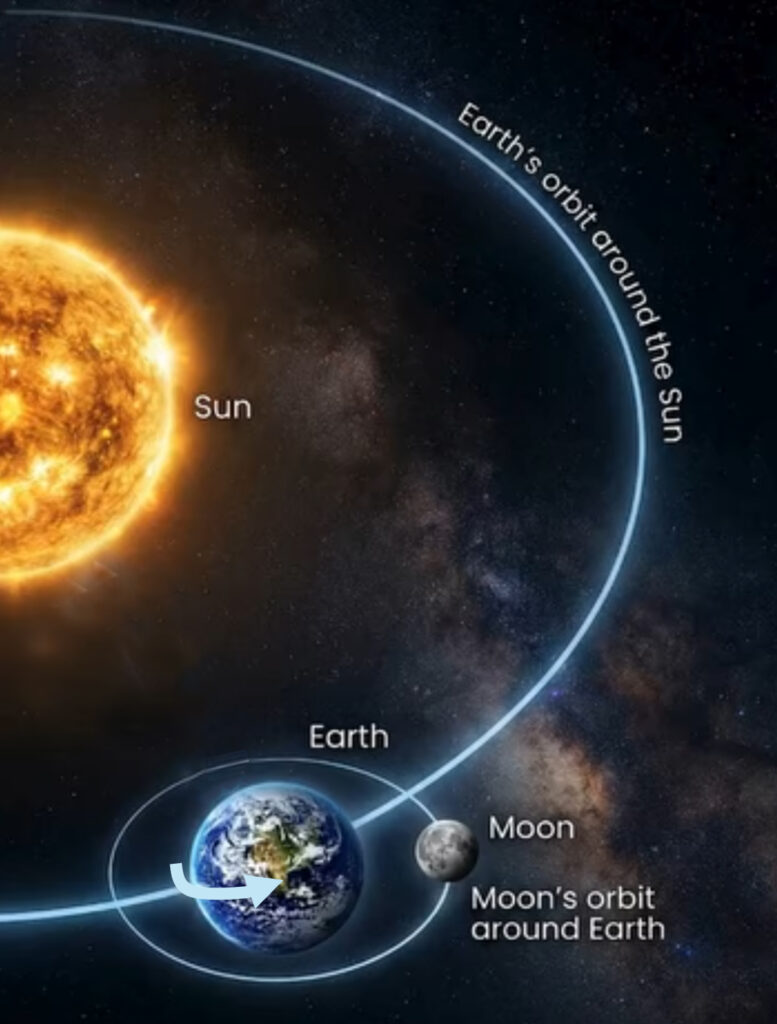
Explaining the cycles and orbits of the earth and moon in relation to the sun …
With reference to the illustration opposite …
1. The earth rotates on its tilted axis counterclockwise (from West to East), a full rotation in 24 hours. This establishes the 24-hour day [a day and night in Hebrew reckoning].
2. At the same time as the earth rotates on its axis, it orbits the sun over 365.24 days, establishing a solar year.
3. At the same time of the rotating earth’s orbit around the sun, the moon orbits around the earth, with one full orbit in each lunar month.
4. Twelve orbits of the moon around the earth (12 lunar months) constitutes a lunar year.
5. A standard solar year is 365.24 days, whilst a 12-month lunar year is about 354.37 days. This leaves a difference of approximately 10.88 days (rounded to 11 days) each year.
6. Based on the foregoing, the average between a solar year and lunar year is 359.8 days (rounded to 360 days).
7. In terms of geometry, the path of a circle travels 360 degrees to complete a cycle. This is related to the Bible TIME measure, equating to a full cycle of events.
A Prophetic Day equals a Calendar Year
Prophetic time measures in the Bible use symbolic numbers and specialized units, primarily found in Daniel and Revelation. Key expressions include the “day-for-a-year principle” (where God appointed a prophetic day to represent a calendar year) …
Numbers 14:33-34 And your children shall wander in the wilderness forty years, and bear your whoredoms, until your carcases be wasted in the wilderness. After the number of the days in which ye searched the land, even forty days, each day for a year, shall ye bear your iniquities, even forty years, and ye shall know my breach of promise.
Ezekiel 4:6 And when thou hast accomplished them, lie again on thy right side, and thou shalt bear the iniquity of the house of Judah forty days: I have appointed thee each day for a year.
A TIME, TIMES and HALF A TIME – Applying the Day-for-a-Year Principle
The Bible establishes a 360-day prophetic year, and specifies terms like “times, time, and half (or dividing of) a time“.
Key Prophetic Units and Equivalents
- A Time: Fundamentally means one year (calculated as 360 days). This is the average of the solar and lunar year as previously explained. Applying the day-for-a-year principle, a Prophetic Time thus equates to 360 calendar years.
- Times: Means two years (dual Hebrew grammatical form). Again, applying the day-for-a-year principle, Prophetic Times thus equates to 720 calendar years.
- Half a Time: Means half a year (180 days). Again, applying the day-for-a-year principle, Half (or the Dividing of) a Prophetic Time thus equates to 180 calendar years.
- Time, Times, and Half a Time: This gives a total of 3.5 years, or 42 months, or 1,260 days (Daniel 7:25, Revelation 12:14). Again, applying the day-for-a-year principle, gives 1260 calendar years.
- Forty-Two Months: Equal to 1,260 days or 3.5 prophetic years (Revelation 11:2, 13:5).
- Seven Times: Equal to 7 x 360 = 2520 days. Again, applying the day-for-a-year principle, gives 2520 calendar years.
SUMMARY OF PROPHETIC TIME MEASURES USED IN THE BIBLE
(Applying the “DAY-FOR-A-YEAR” Principle)
PROPHETIC |
CALENDAR |
| A DAY | 1 YEAR |
| A WEEK | 7 YEARS |
| A MONTH | 30 YEARS |
| A SEASON | 90 YEARS |
| A TIME | 360 YEARS |
| TIMES | 720 YEARS |
| HALF A TIME | 180 YEARS |
| DIVIDING OF TIME | 180 YEARS |
| 3 & HALF TIMES | 1260 YEARS |
| 42 MONTHS | 1260 YEARS |
| 7 TIMES | 2520 YEARS |